Up on the Housetop on the ocarina
On a 12-hole it starts G, G, A, G. Easy, 66 notes, in C major.
Up on the Housetop
Bar 1 of 16
What are the notes for Up on the Housetop?
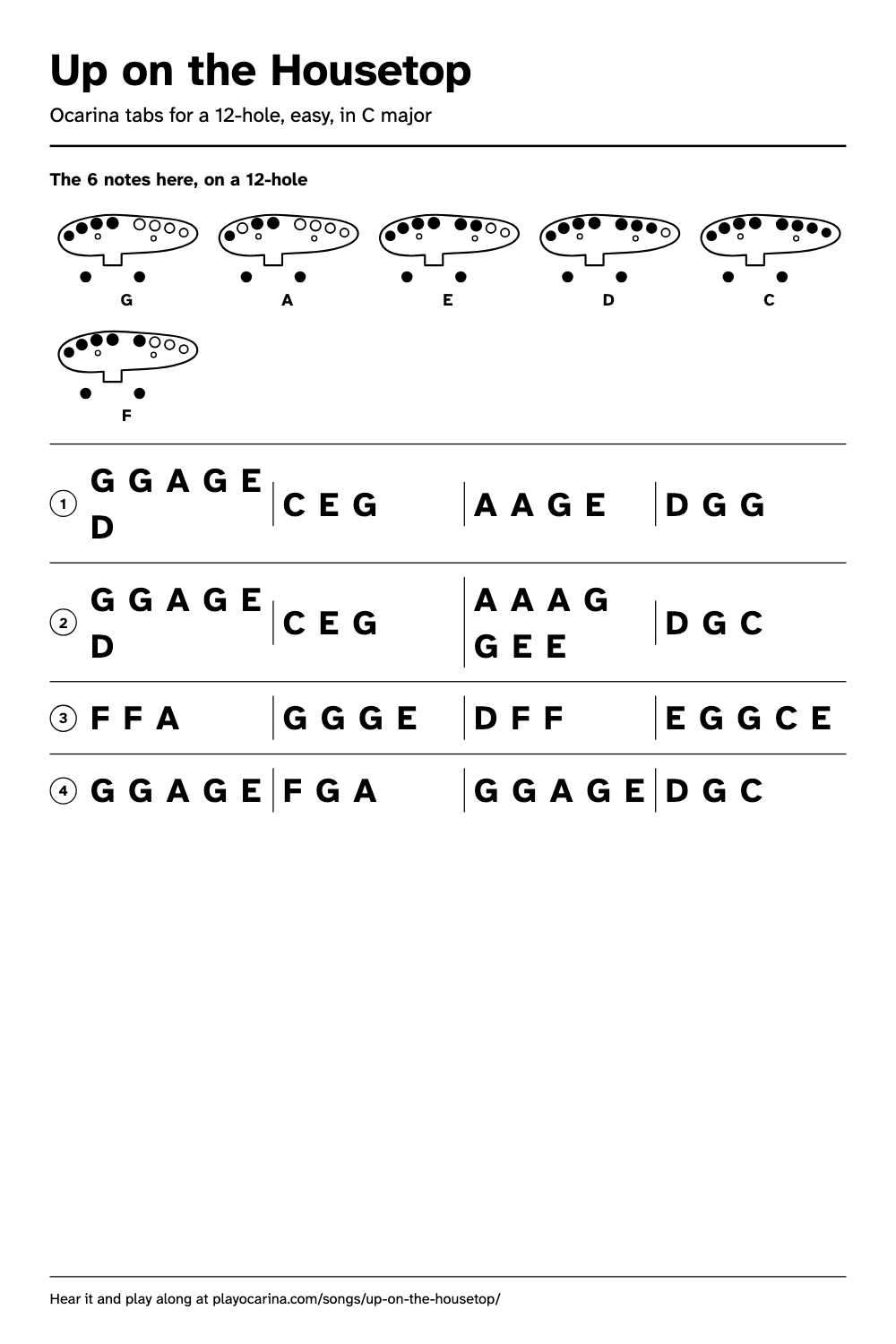
On a 12-hole. Read left to right, a line at a time.
- GGAGEDCEGAAGEDGG
- GGAGEDCEGAAAGGEETricky spot:DGC
- FFAGGGEDFFEGGCE
- GGAGEFGAGGAGEDGC
Up on the Housetop bounces along in C major on just six notes, C, D, E, F, G and A. The verse is two near-identical lines that each end on a long note; the chorus starts with the "Ho, ho, ho" calls, F, F and a long A, then G, G, G and a long E. With nothing below low C or above A, it fits a 12-hole, a 6-hole and even a 4-hole ocarina in C.
What is the tricky spot in Up on the Housetop?
The last step of each half, where the tune drops a fifth from G to the long low C that ends it. On a 12-hole, Up on the Housetop goes from G to C: you cover the right index, right middle, right ring and right pinky. On a 6-hole or 4-hole, you cover the left middle and right middle.
Let the air relax as you fall to the low C, which wants a softer, slower breath than the G above it, or it will jump up an octave. The quick pairs are the other thing to practise: near the end of the verse the tune runs A, A, G, G, E, E in eighths, so tongue each note with a light "tu" and keep them even (how to tongue repeated notes). In the chorus, give each "Ho" its full beat and hold the long notes for two.
Where do you breathe in Up on the Housetop?
In the verse a two-beat note closes every second bar ("pause", "Claus", "toys", "joys"), each a natural place to breathe. The chorus has a long note in nearly every bar, so breathe on the long A of the first "Ho, ho, ho" and the long F of the second rather than on each one.
Which ocarina can play Up on the Housetop?
Any 12-hole, 6-hole or 4-hole ocarina in C plays Up on the Housetop in this key. On an ocarina in G or F, use the same fingerings: the tune sounds in a different key, which is fine when you play alone. Each linked chart has every fingering for its ocarina, and you can check your notes with a tuner such as our free ocarina tuner.
The 6 notes here, on a 12-holeHoles in words, with a picture
| Note | Holes to cover | Picture |
|---|---|---|
| G | Cover every main hole but the right index, right middle, right ring and right pinky | |
| A | Cover the left pinky, left middle, left index, left thumb and right thumb | |
| E | Cover every main hole but the right ring and right pinky | |
| D | Cover every main hole but the right pinky | |
| C | Cover every main hole | |
| F | Cover every main hole but the right middle, right ring and right pinky |
Drawn as you see it while playing: mouthpiece towards you, left hand on the left.
| Note | Holes to cover | Picture |
|---|---|---|
| G | Cover every hole but the left middle and right middle | |
| A | Cover the left index, left thumb and right thumb | |
| E | Cover every hole but the right index | |
| D | Cover every hole but the right middle | |
| C | Cover every hole | |
| F | Cover every hole but the right middle and right index |
Drawn as you see it while playing: mouthpiece towards you, left hand on the left.
| Note | Holes to cover | Picture |
|---|---|---|
| G | Cover the left index and right index | |
| A | Cover the left index | |
| E | Cover every hole but the right index | |
| D | Cover every hole but the right middle | |
| C | Cover every hole | |
| F | Cover the left middle and left index |
Drawn as you see it while playing: mouthpiece towards you, left hand on the left.
Who wrote Up on the Housetop?
Benjamin Hanby, a young Ohio minister and teacher. He wrote it in 1864 for the singing school he ran in New Paris, Ohio, and it is said to be the first Christmas song mainly about Santa Claus. Its first title was "Santa Claus", which is how a Chicago Sunday school songbook of 1866, edited by George F. Root and Hanby himself, prints it, in quick 2/4. Hanby died of tuberculosis in 1867, aged 33. Our tabs follow the four-beat version in The Golden Book of Favorite Songs, printed in Chicago in 1923, moved from E flat into C. We show the melody only. Music: words and music by Benjamin Hanby (1833-1867).