We Three Kings on the ocarina
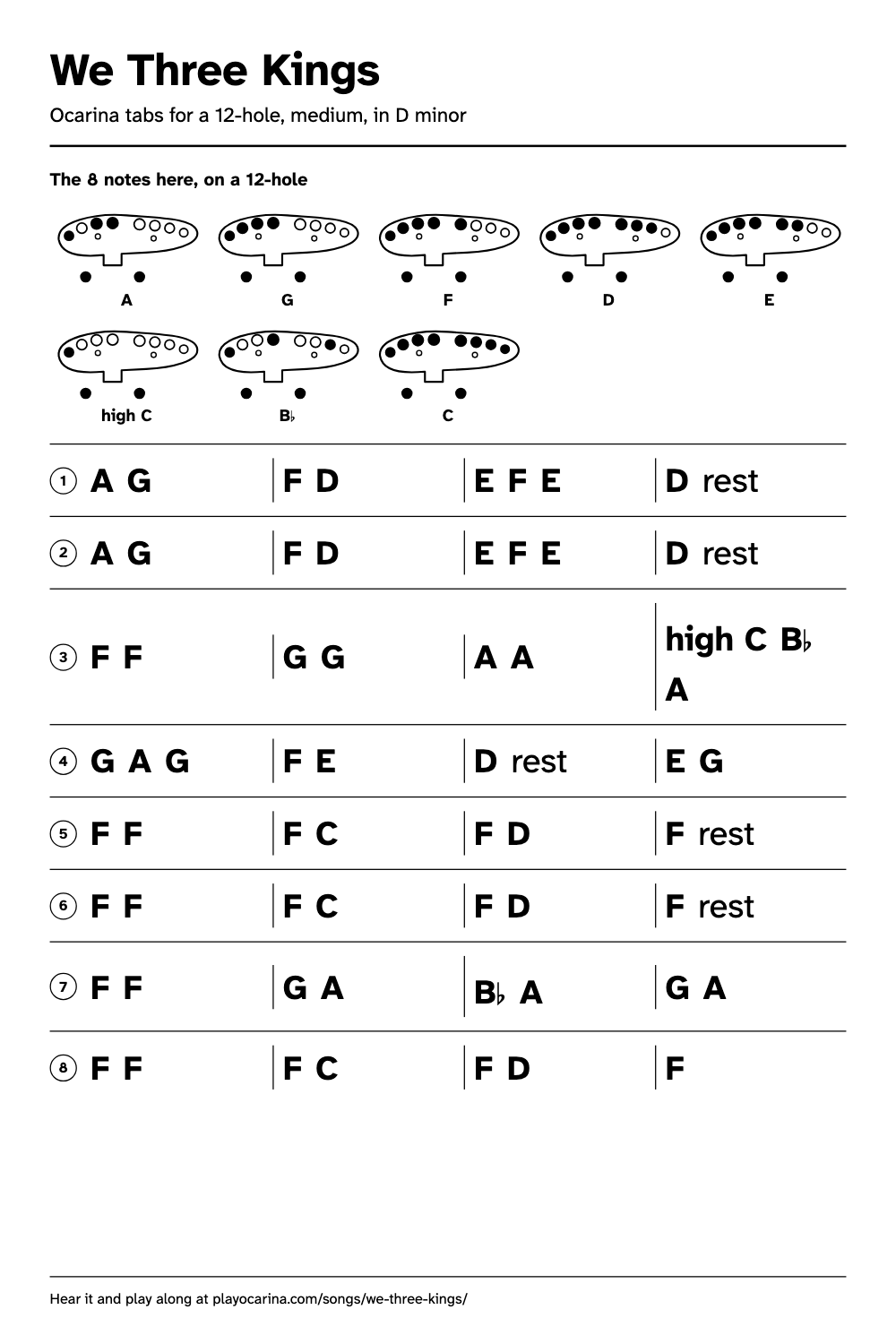
On a 12-hole it starts A, G, F, D. Medium, 62 notes, in D minor.
We Three Kings
Bar 1 of 32
What are the notes for We Three Kings?
On a 12-hole. Read left to right, a line at a time.
- AGFDEFEDrest
- AGFDEFEDrest
- FFGGAAhigh CB♭A
- GAGFEDrestEG
- FFTricky spot:FCFDFrest
- FFFCFDFrest
- FFGAB♭AGA
- FFFCFDF
We Three Kings swings in threes: almost every bar is a long note and a short one, like a camel's sway. The verse is in D minor and the chorus turns bright, in F major, and both stay between C and high C with B♭ as the only flat, so a 12-hole, a 6-hole and a 4-hole ocarina in C all play it. The chorus keeps coming back to F, so once you have that note in tune most of the chorus follows.
What is the tricky spot in We Three Kings?
The chorus, where the tune keeps leaving F for a short note below it: down a fourth to low C, then back up, and later down to D. On a 12-hole, We Three Kings goes from F to C: you cover the right middle, right ring and right pinky. On a 6-hole or 4-hole, you cover the right middle and right index.
Play F, F, C slowly, then F, D, letting each short note drop cleanly without a slide; low C needs every hole covered, so check your fingers seal before the chorus starts. Keep the long-short rhythm even: the long note gets two counts of three, the short one gets one. The chorus opens with E held, then a quick G: slur the two together in one breath. In the verse, the run E, F, E is three quick even notes, so tongue them lightly. B♭ comes twice, in the verse's third line and near the end of the chorus; it is a cross-fingering on a 12-hole, so practise A, B♭, A on its own.
Where do you breathe in We Three Kings?
The printing has a short rest at the end of each line of the verse and after the first two lines of the chorus: breathe in those rests. From there the chorus runs to its last note with no rest, so take a quick breath halfway: shorten the A that follows B♭, A, G.
Which ocarina can play We Three Kings?
Any 12-hole, 6-hole or 4-hole ocarina in C plays We Three Kings in this key. On an ocarina in G or F, use the same fingerings: the tune sounds in a different key, which is fine when you play alone. Each linked chart has every fingering for its ocarina, and you can check your notes with a tuner such as our free ocarina tuner.
The 8 notes here, on a 12-holeHoles in words, with a picture
| Note | Holes to cover | Picture |
|---|---|---|
| A | Cover the left pinky, left middle, left index, left thumb and right thumb | |
| G | Cover every main hole but the right index, right middle, right ring and right pinky | |
| F | Cover every main hole but the right middle, right ring and right pinky | |
| D | Cover every main hole but the right pinky | |
| E | Cover every main hole but the right ring and right pinky | |
| high C | Cover the left pinky, left thumb and right thumb | |
| B♭ | Cover the left pinky, left index, right ring, left thumb and right thumb | |
| C | Cover every main hole |
Drawn as you see it while playing: mouthpiece towards you, left hand on the left.
| Note | Holes to cover | Picture |
|---|---|---|
| A | Cover the left index, left thumb and right thumb | |
| G | Cover every hole but the left middle and right middle | |
| F | Cover every hole but the right middle and right index | |
| D | Cover every hole but the right middle | |
| E | Cover every hole but the right index | |
| high C | Cover the left thumb and right thumb | |
| B♭ | Cover the right index, left thumb and right thumb | |
| C | Cover every hole |
Drawn as you see it while playing: mouthpiece towards you, left hand on the left.
| Note | Holes to cover | Picture |
|---|---|---|
| A | Cover the left index | |
| G | Cover the left index and right index | |
| F | Cover the left middle and left index | |
| D | Cover every hole but the right middle | |
| E | Cover every hole but the right index | |
| high C | All holes open | |
| B♭ | Cover the right index | |
| C | Cover every hole |
Drawn as you see it while playing: mouthpiece towards you, left hand on the left.
Who wrote We Three Kings?
One man wrote all of it. John Henry Hopkins Jr. wrote the words and the tune in 1857 for a Christmas pageant in New York, and it became the first widely popular carol written in America. He printed it himself in 1863, in his book Carols, Hymns, and Songs, and our tabs follow that first printing. There each king has his own staff, Gaspard, Melchior and Balthazar, and a note says the music is "set in the G clef for the accommodation of children". The tune we teach is Gaspard's line, with the top line of the chorus, moved down a tone. Hopkins died in 1891. Music: words and music by John Henry Hopkins Jr. (1820-1891), written in 1857.